
AIGW Practitioner Toolkit 01 · Pilot v1.0
Where Does the Work Go?
The AI Workforce Transition Evidence & Measurement Toolkit
AI may change how long work takes. This toolkit helps teams trace where that capacity goes—and what actually changes for workers and the business.
A practical first pilot
Follow 3–5 workflows over 30 days, then bring the evidence and its gaps to a decision meeting.
For CHROs, HR and HRBP teams, L&D, workforce planners, transformation and operational leaders.
The workbook is available by request. On the contact page, tell us you are interested in the Where Does the Work Go? pilot.
Time saved is the beginning of the question
Hours and worker-equivalent estimates do not establish who moved, whether quality held, or whether value was realized. Each conclusion needs its own evidence.
Practitioner Guide
A free 12-page guide to definitions, measurement and evidence limits.
Decision Worksheet
A free two-page worksheet for recording evidence, decisions and owners.
Evidence Ledger
A 10-tab Excel workbook for a request-only pilot, with formulas, a decision log and a synthetic example.
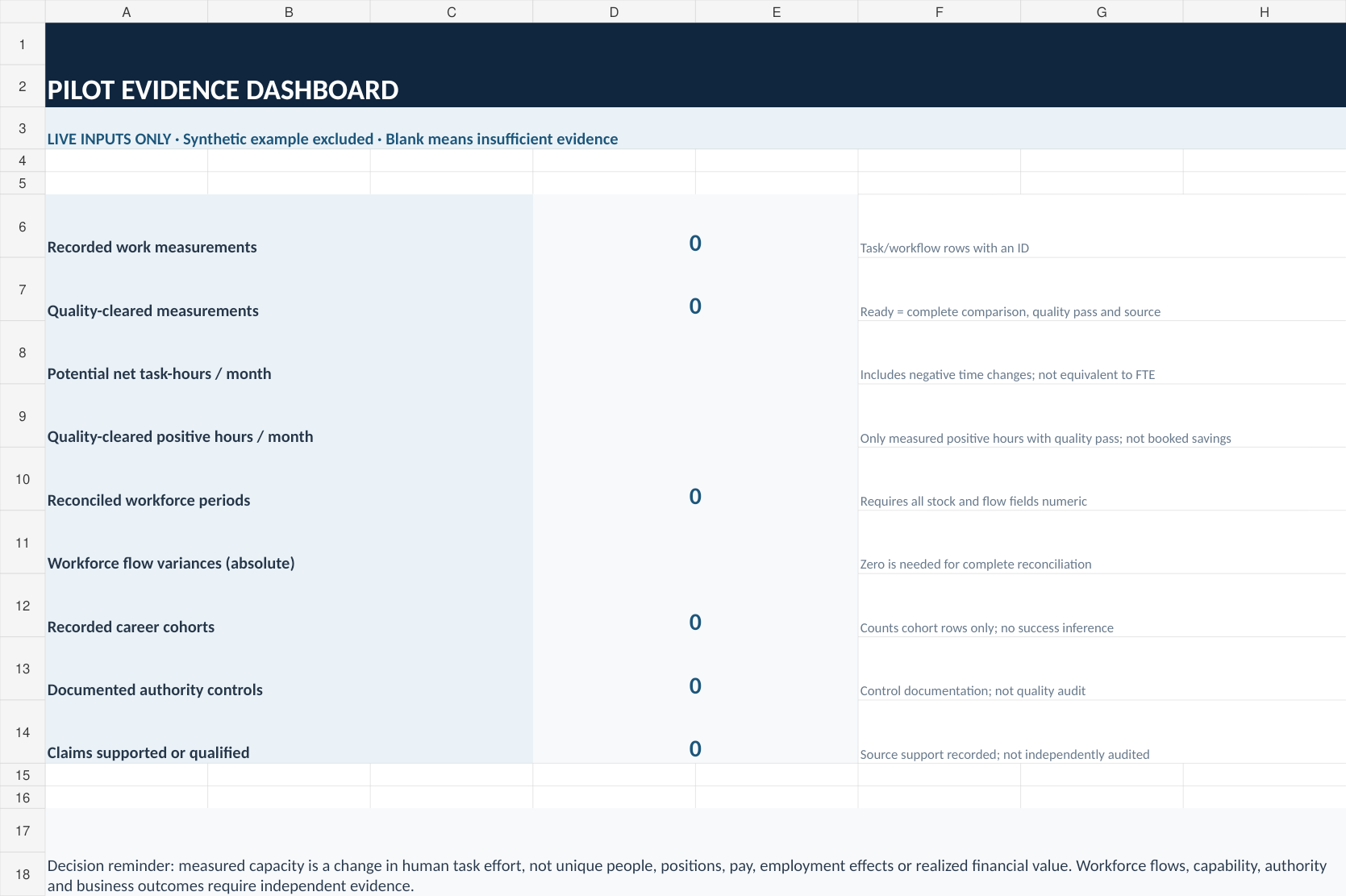
Dashboard preview
An illustrative view of the evidence a team can bring together—not a company result.
From measurement to decision
Follow the work. Then follow the evidence.
The steps connect task-level measurement to workforce outcomes without treating one as proof of the other.
- 01
Measure comparable work
Define an accepted work unit and compare human effort, including review and rework.
- 02
Validate quality
Check defects, exceptions and risk before treating any time as released capacity.
- 03
Trace the destination
Look for documented changes in assignments, demand, learning or work volume.
- 04
Reconcile workforce flows
Compare actual hires, transfers and exits separately from capacity estimates.
- 05
Make an evidence-led decision
Review human authority, worker outcomes and business evidence before deciding what to do next.
Illustrative dashboard
Keep evidence gaps visible
The dashboard brings work measurement, quality, workforce flows and authority controls into one view. Blank values signal insufficient evidence, not zero impact.
Illustrative preview only. It does not contain company or employee data.
A 30-day path
Start with 3–5 workflows and named owners. Keep the work manageable enough to investigate quality and people outcomes, not just speed.
Days 1–5
Select workflows, define quality and establish a baseline.
Days 6–15
Observe AI-assisted work and record human review and rework.
Days 16–22
Trace assignments, workforce flows, capability and authority.
Days 23–30
Reconcile evidence, examine alternatives and decide what comes next.
What the toolkit can—and cannot—show
It helps a team organize comparable measurements, verify documented movements and identify what remains unknown. A slower workflow, a failed quality check or missing evidence belongs in the record.
It is not a validated maturity score, causal employment analysis, certified audit or guarantee of ROI. Saved hours and FTE-equivalent capacity do not establish job losses, redeployments or realized financial savings.
Research behind the toolkit
- Workforce Architecture for the AI Enterprise
The research framework behind the toolkit.
- Wipro: AI productivity and redeployment
Why a capacity estimate is not a count of worker transitions.
- TCS: From training to assignment
How to distinguish learning from verified assignments and career outcomes.
- Salesforce and Agentforce
Evidence on redeployment, support work and the limits of workforce-flow data.
Ready to investigate one workflow?
Start with the free guide and worksheet, or contact us about a workbook pilot.