
Institutional DialoguesInstitutional DialogueGlobal
AI & Education Policy Dialogue: What Works, What Breaks, and What's Next
Institutional intelligence asset from the Observatory.
March 8, 2026
Conversations and convenings
Conversations, roundtables, podcasts, and event replays with practitioners, experts, enterprise leaders, and institutional actors working on AI governance and workforce transformation. This library also preserves earlier education-era dialogues as legacy context.
Interviews, conversations, roundtables, podcasts, and event replays with institutional leaders and practitioners.
Library filters
Search by asset type, audience, geography, theme, and year.
Institutional intelligence asset from the Observatory.
Institutional intelligence asset from the Observatory.
Generative AI is transforming education, especially writing. In a conversation with Swiss AI founder Yves Zumbühl, Qiqing He discusses practical AI implementation through PaperCheck, a writing-focused tool. Key themes include adoption in real classrooms, integrity-by-design, narrow measurable use cases, and institution-ready standards for trust, privacy, and outcomes.
Join policymakers from 40+ countries to discuss the regulatory framework for AI in classrooms.
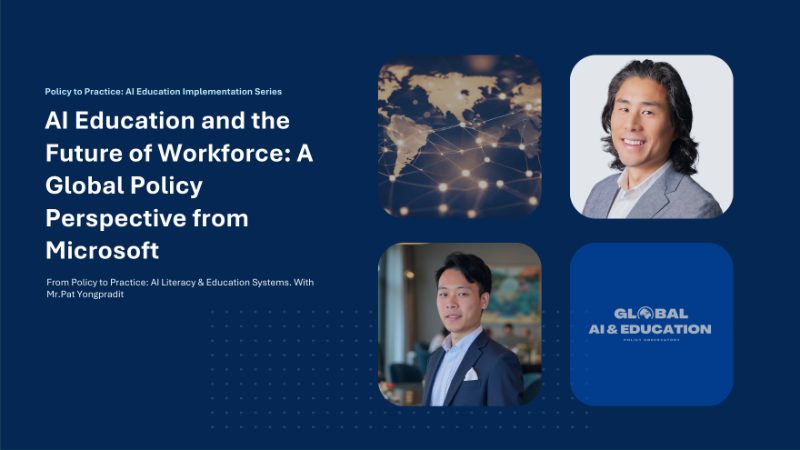
Join Mr. Pat Yongpradit, Microsoft Global Education and Workforce Policy General Manager, for an exclusive session on shaping AI policy in education.
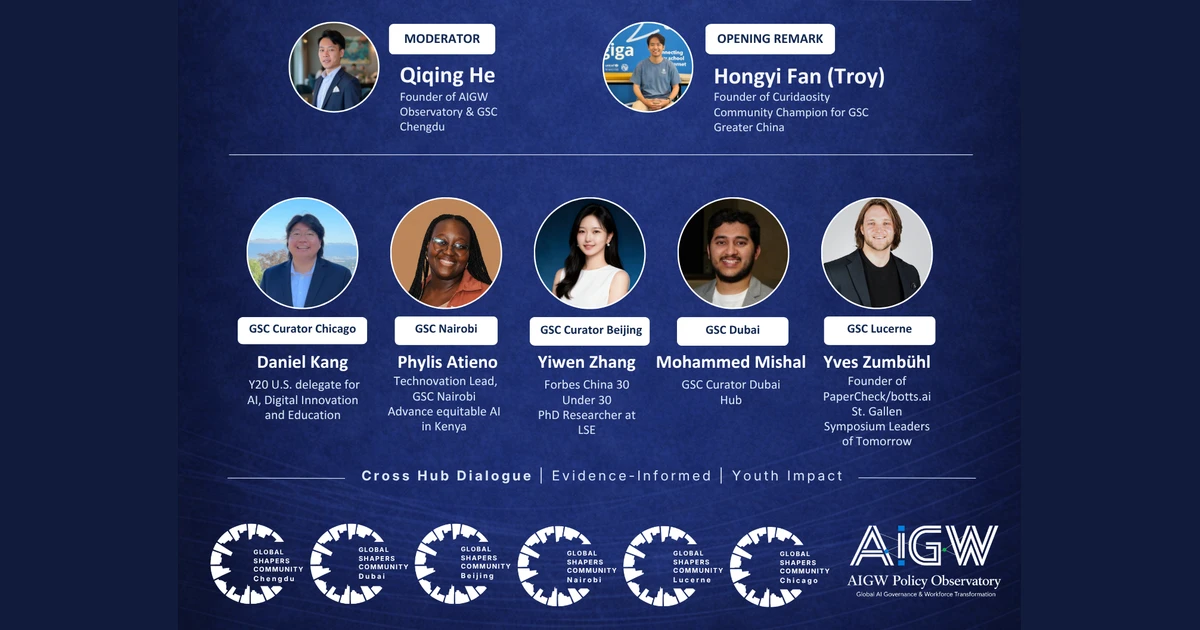
What does responsible, inclusive AI in education actually look like across different national contexts? In this cross-hub dialogue, young leaders and practitioners from Chicago, Nairobi, Beijing, Dubai, and Lucerne come together to discuss what is working, what is breaking, and what should happen next as AI moves into education systems around the world. This session explores:
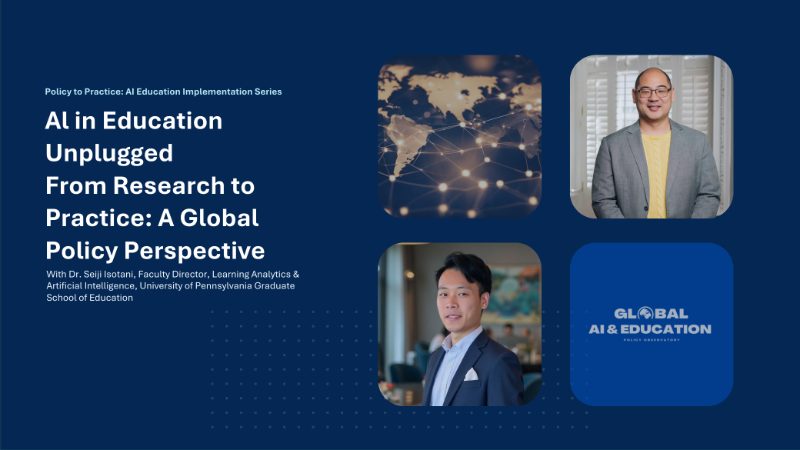
How can AI reach the students who need it the most — especially in places where internet access, devices, or infrastructure are limited? One of the most inspiring aspects of Dr. Isotani’s work is the development of AI “Unplugged” learning approaches. Instead of assuming constant connectivity or advanced devices, his research explores ways students can still learn the concepts behind AI through activities, structured exercises, and low-tech educational tools.
Institutional intelligence asset from the Observatory.
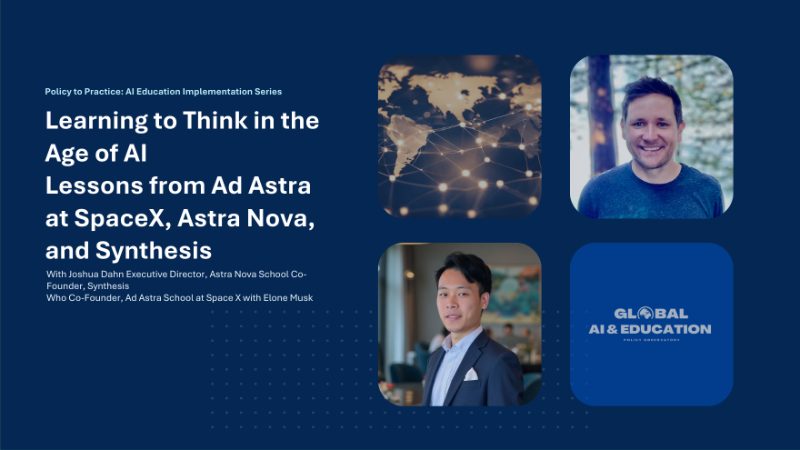
How should education evolve in the age of AI? Long before AI became a mainstream public conversation, Josh was already working on bold experiments in learning, interdisciplinary education, problem-solving, and critical thinking. Even by today’s standards, his work remains strikingly ahead of its time, which makes it all the more remarkable that he began building in this direction nearly a decade ago. In this interview, we explore: what traditional education systems still struggle to do well why critical thinking and collaborative problem-solving matter more than ever how AI is changing the meaning of learning what kind of schools and learning environments may better prepare young people for the future This clip features the opening part of our conversation and offers a window into the thinking behind some of the most forward-looking experiments in modern education.

Institutional intelligence asset from the Observatory.
How AI is shifting the paradigm from standardized testing to continuous adaptive assessment.