Signals and interpretation

Institutional Intelligence

Interpreted signals and briefings on AI governance, workforce transformation, enterprise implementation, and institutional adaptation.

Interpreted AI governance, workforce, risk, and implementation signals for institutional decision-makers.

Library filters

Search by asset type, audience, geography, theme, and year.

27 assets
Capacity LabAdvisory NoteGlobal

What Anthropic–PwC Reveals About the Limits of Outsourcing AI Readiness

As frontier AI firms and professional-services firms move deeper into enterprise deployment, a tempting assumption is emerging: if AI implementation is hard, the answer is to bring in a stronger partn…

May 20, 2026
IntelligenceAdvisory NoteUnited States

What OpenAI, GitLab, Gartner and the EU AI Act Reveal About the Next Enterprise AI Bottleneck

Recent signals from OpenAI, GitLab, Gartner, and the European Commission suggest that enterprise AI adoption is entering a new phase. The challenge is no longer simply whether organizations can access powerful AI tools, but whether they can redesign workflows, govern agents, prepare semantic infrastructure, and operationalize transparency requirements.

May 13, 2026
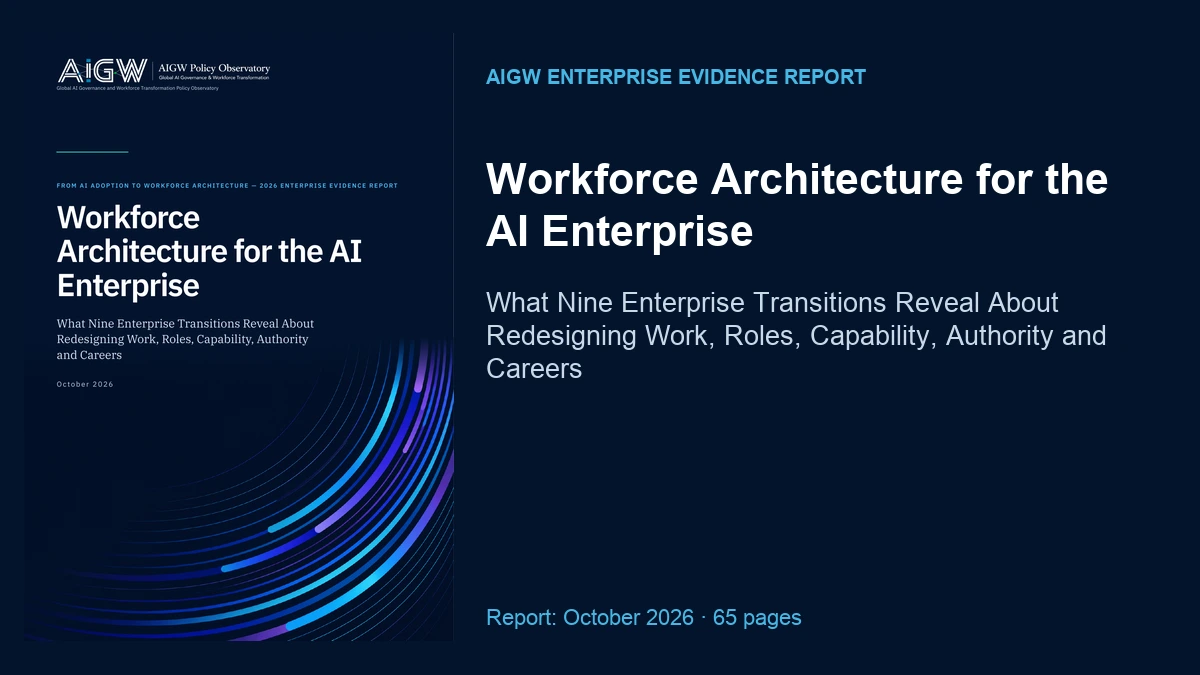
From AI Adoption to Workforce Architecture: Building the Next Phase of Human-Centered Workforce Transformation
Capacity LabComparative Governance BriefGlobal

From AI Adoption to Workforce Architecture: Building the Next Phase of Human-Centered Workforce Transformation

AI workforce transformation is moving beyond tool adoption. This policy brief explains why enterprises need workforce architecture — integrating strategy, workflows, roles, capabilities, governance, and trust — to scale responsible, human-centered AI adoption

5/6/2026
Case LibraryEnterprise Implementation CaseGlobal

Merck’s $1 Billion AI Move and the Real Shift From Pilot to Production

Merck’s multi-year AI partnership with Google Cloud is more than a major technology investment. It is a high-value signal that enterprise AI is moving from isolated pilots to cross-functional operating-model redesign. This case brief extracts what the move reveals about pilot-to-production transition, institutional readiness, and the organizational conditions required for AI to scale inside real enterprises.

emerging-pattern
Capacity LabAdvisory NoteUnited States

Before Scaling AI, Build the Operating Model

Companies are discovering that AI pilots are easy to launch but difficult to absorb. At the early stage of enterprise AI rewarded experimentation. Teams tested copilots, employees tried new tools, exe…

May 6, 2026
Case LibraryRisk CaseGlobal

When AI Transformation Breaks Workforce Trust: Signal from WiseTech

AI workforce transformation is now entering a more difficult phase.The first phase was mostly about adoption: which tools employees should use, how much productivity they could unl…

May 9, 2026
Case LibraryEnterprise Implementation CaseGlobal

AI’s Move Into Managerial Workflows: What Amazon and Accenture Reveal

AI is moving from individual productivity assistance into managerial workflows.That distinction matters. A productivity tool helps an employee work faster, summarize a document, pr…

May 4, 2026
Policy TrackerCountry Governance ProfileChina

AI Governance Is Becoming an Operating-Speed Problem: China and the United States in Action

AI governance is entering a more operational phase.<div><br></div><div>For the past several years, much of the public debate has focused on principles: safety, fairness, transparency, privacy, account…

May 3, 2026
From AI Pilots to Governed Adoption: Why Institutional Readiness Determines the Next Phase of AI Transformation
Capacity LabComparative Governance BriefGlobal

From AI Pilots to Governed Adoption: Why Institutional Readiness Determines the Next Phase of AI Transformation

As AI adoption accelerates across sectors, the central challenge is no longer access to tools but the ability of institutions to redesign workflows, governance, and workforce systems around them. This flagship brief from the Global AI Governance and Workforce Transformation Policy Observatory examines why many organizations remain trapped in fragmented experimentation and outlines a practical framework for moving toward governed, scalable implementation.

4/24/2026
Capacity LabAdvisory NoteGlobal

From AI Adoption to Workforce Architecture: What CHROs and Policymakers Must Build Next

Enterprise AI transformation is moving from an adoption challenge to an institutional readiness challenge.<div><br></div><div>The first phase of enterprise AI was defined by access to tools. The secon…

May 2, 2026
Exiting the AI Pilot Trap: Responsible Scale for AI Literacy, Governance, and Workforce Readiness
IntelligenceReleaseGlobal

Exiting the AI Pilot Trap: Responsible Scale for AI Literacy, Governance, and Workforce Readiness

This brief synthesizes evidence and expert dialogue on scaling AI literacy and governance beyond pilots. It argues for treating AI literacy as baseline infrastructure, aligning responsible-use policy with cybersecurity maturity, and preparing for workforce change as task-displacement first.

2026-02-26
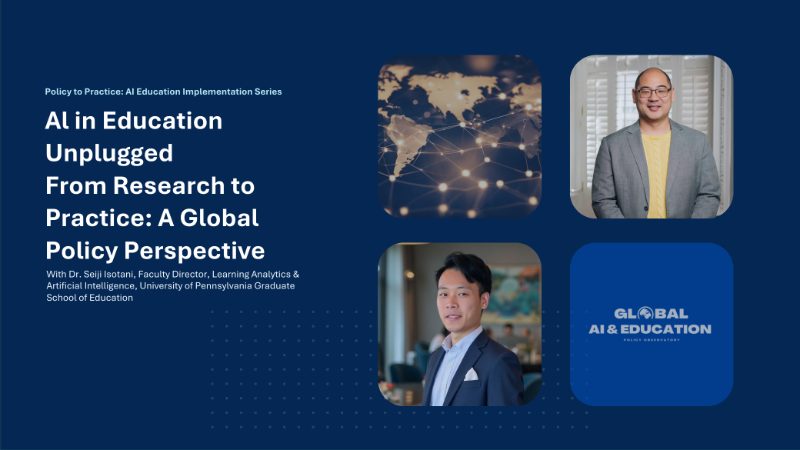
AI in Education Unplugged: Closing the Access Gap Through Education-Driven Design
IntelligenceReleaseGlobal

AI in Education Unplugged: Closing the Access Gap Through Education-Driven Design

Artificial intelligence is transforming education, but its benefits remain out of reach for many of the communities that could benefit most. Drawing primarily from an hour-long public interview with Dr. Seiji Isotani and secondarily from the OECD Digital Education Outlook 2026 interview chapter, this memo argues that policymakers should stop treating infrastructure build-out as a precondition for AI in education. Instead, they should design around the infrastructure that already exists—especially mobile phones, intermittent connectivity, and teacher-led delivery models. The Brazil case discussed by Dr. Isotani shows that this approach can work at scale: 500,000 students across 7,000 schools and 20,000 teachers received materially faster feedback on writing, with statistically significant improvement and no meaningful urban-rural or resource-based gap in gains.

2026-03-10
IntelligenceAdvisory NoteGlobal

Who Controls the Enterprise AI Adoption Layer? Model companies, cloud platforms, domestic hardware ecosystems, or the institutions deploying AI?

Enterprise AI is crossing a threshold: from tools employees test to systems organizations begin to rely on.As adoption scales, the strategic risk is not simply choosing the wrong m…

April 25, 2026
Capacity LabAdvisory NoteGlobal

What Google and IBM Reveal About the Next Policy Challenge in Enterprise AI

Google and IBM’s latest enterprise AI moves matter for a reason that goes beyond vendor competition. Read narrowly, they are product and platform announcements. Read together, they point to a broader …

April 23, 2026
Capacity LabAdvisory NoteGlobal

From BlackRock to UNESCO: AI’s Next Challenge Is Institutional Design

Artificial intelligence is still often framed as a race of models, tools and technical breakthroughs. But the more consequential shift is now happening elsewhere. Across enterprise, public education a…

April 22, 2026
IntelligenceAdvisory NoteGlobal

AI Workforce Transformation Is Not a Tool Problem. It Is a Human and Organizational One

AI is no longer a question of whether organizations should adopt it. The more serious question is whether they are prepared to reorganize work around it. Many firms already have AI activity - teams ar…

April 19, 2026
IntelligenceArticleGlobal

From Hype to Implementation: A Swiss Founder’s Approach to AI-Powered Writing Education

Generative AI is no longer a speculative “future of education” concept—it is actively reshaping how students learn, how teachers assess, and how institutions define academic integrity.

February 16, 2026
How Workers Use, or Don't Use, their Skills in the Workplace
IntelligencePublicationGlobal

How Workers Use, or Don't Use, their Skills in the Workplace

Drawing on the latest Observatory Survey of Adult Skills (PIAAC), this report provides new evidence.

6 February 2026
IntelligenceArticleAfrica

When Opportunity Is Unequal: Girls, Access, and the Fight for AI Education in Nairobi

As AI reshapes education, girls in underserved communities risk being left further behind. This article looks at the realities of access in Nairobi and how Telenovation is creating meaningful pathways into technology and opportunity.

March 19, 2026
IntelligenceArticleGlobal

Is AI Outrunning Humanity? Age of Acceleration

Let’s call this AI teleportation: the shortcut that skips the middle—the struggle, the reasoning, the reflection, the slow building of meaning.

February 10, 2026
Global call for "Governing with Artificial Intelligence": Share your initiatives
IntelligenceArticleGlobal

Global call for "Governing with Artificial Intelligence": Share your initiatives

We are launching a Global Call for Governing with AI, inviting governments to share AI use cases, policy initiatives, and implementation tools.

January 20, 2026
Can mid-sized economies come together to build frontier AI?
IntelligenceArticleGlobal

Can mid-sized economies come together to build frontier AI?

Mid-sized economies can preserve AI sovereignty through multinational cooperation, pooling talent and compute to reduce dependency on dominant AI powers.

December 16, 2025
Institutional DialoguesEvent ReplayGlobal

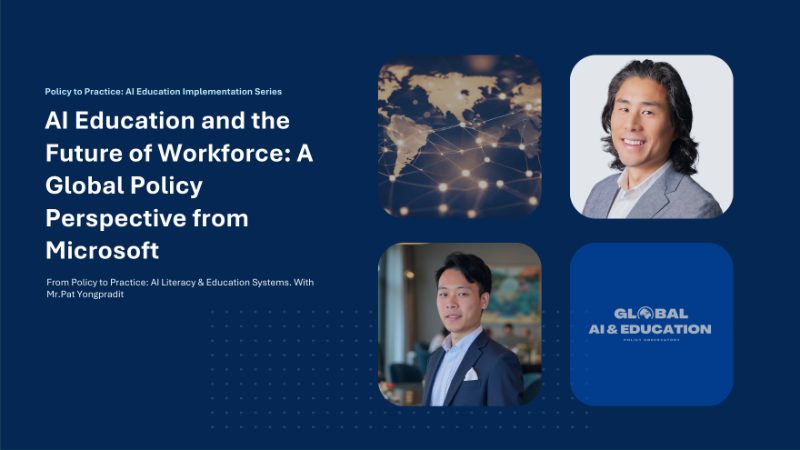
AI Education&Future of Workforce: A Global AI Education Policy Perspective from Microsoft-With Mr.Pat Yongpradit

Institutional intelligence asset from the Observatory.

emerging-pattern
Institutional DialoguesEvent ReplayGlobal

Responsible use of AI in writing

Institutional intelligence asset from the Observatory.

emerging-pattern
Institutional DialoguesEvent ReplayGlobal

AI Education Unplugged

How can AI reach the students who need it the most — especially in places where internet access, devices, or infrastructure are limited? One of the most inspiring aspects of Dr. Isotani’s work is the development of AI “Unplugged” learning approaches. Instead of assuming constant connectivity or advanced devices, his research explores ways students can still learn the concepts behind AI through activities, structured exercises, and low-tech educational tools.

emerging-pattern
Institutional DialoguesEvent ReplayAfrica

AI & Education Policy Dialogue | What Works, What Breaks, and What’s Next-voice from 5 countries

What does responsible, inclusive AI in education actually look like across different national contexts? In this cross-hub dialogue, young leaders and practitioners from Chicago, Nairobi, Beijing, Dubai, and Lucerne come together to discuss what is working, what is breaking, and what should happen next as AI moves into education systems around the world. This session explores:

emerging-pattern
Institutional DialoguesEvent ReplayGlobal

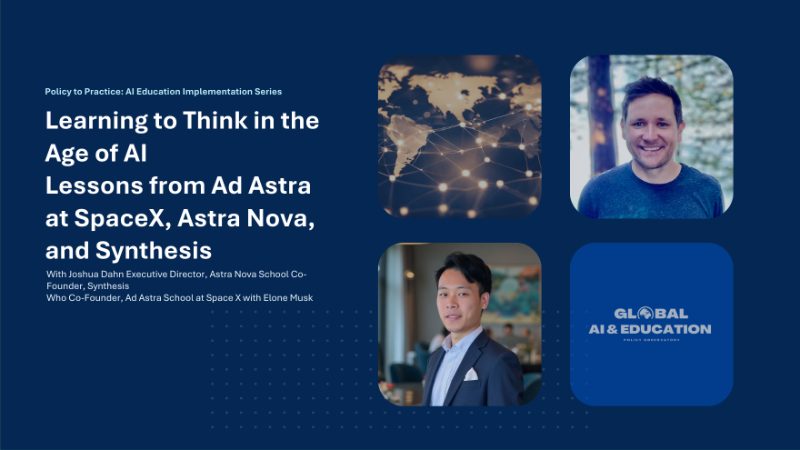
Learning to Think in the Age of AI Lessons from Ad Astra at SpaceX, Astra Nova, and Synthesis

How should education evolve in the age of AI? Long before AI became a mainstream public conversation, Josh was already working on bold experiments in learning, interdisciplinary education, problem-solving, and critical thinking. Even by today’s standards, his work remains strikingly ahead of its time, which makes it all the more remarkable that he began building in this direction nearly a decade ago. In this interview, we explore: what traditional education systems still struggle to do well why critical thinking and collaborative problem-solving matter more than ever how AI is changing the meaning of learning what kind of schools and learning environments may better prepare young people for the future This clip features the opening part of our conversation and offers a window into the thinking behind some of the most forward-looking experiments in modern education.

emerging-pattern