
ArticlePrimary China evidence
China’s 15th Five-Year Plan: How AI Is Reshaping Governance and the Future of Work
A guide to China’s 2026–2030 framework for AI adoption, employment transition, public-sector transformation and risk governance
Country workforce transformation hub
A source-led view of how AI is changing tasks, workflows, decision rights, roles, and pathways across Chinese enterprises and public systems.
Evidence boundary: adoption and productivity claims alone do not establish net employment effects or worker benefit. The records below distinguish observed work changes from workforce responses and measured outcomes.
Recent, explicitly classified analysis with China as a primary or materially relevant geography. Text-only mentions are not included.
A guide to China’s 2026–2030 framework for AI adoption, employment transition, public-sector transformation and risk governance
Published tracker signals and approved case records with source-supported work-change evidence. Each item links to its underlying public record.
Customer-service experience is being repurposed into training, configuring and improving AI service systems, with reported job conversion at scale.
JD.com · E4 evidence
AI performs the initial assessment of student code that teachers previously reviewed line-by-line.
Beijing No. 35 High School · E3 evidence
AI performs substantial visual quality inspection, human workers verify flagged defects, and a documented former frontline quality inspector transitioned into AI-model training using frontline inspection expertise.
LONGi Green Energy · E4 evidence
AI generates an initial head-CT report draft that is then reviewed and finalized by a doctor.
Beijing Tiantan Hospital · E4 evidence
CodeBuddy is embedded across Tencent engineering workflows and materially reduces coding time.
Tencent · E4 evidence
Vision systems, robots and other embodied-AI systems perform inspection, handling, patrol and logistics tasks inside the factory.
Midea, Jingzhou washing-machine factory · E4 evidence
Published research and normalized releases with an explicit China scope and workforce-transformation classification.
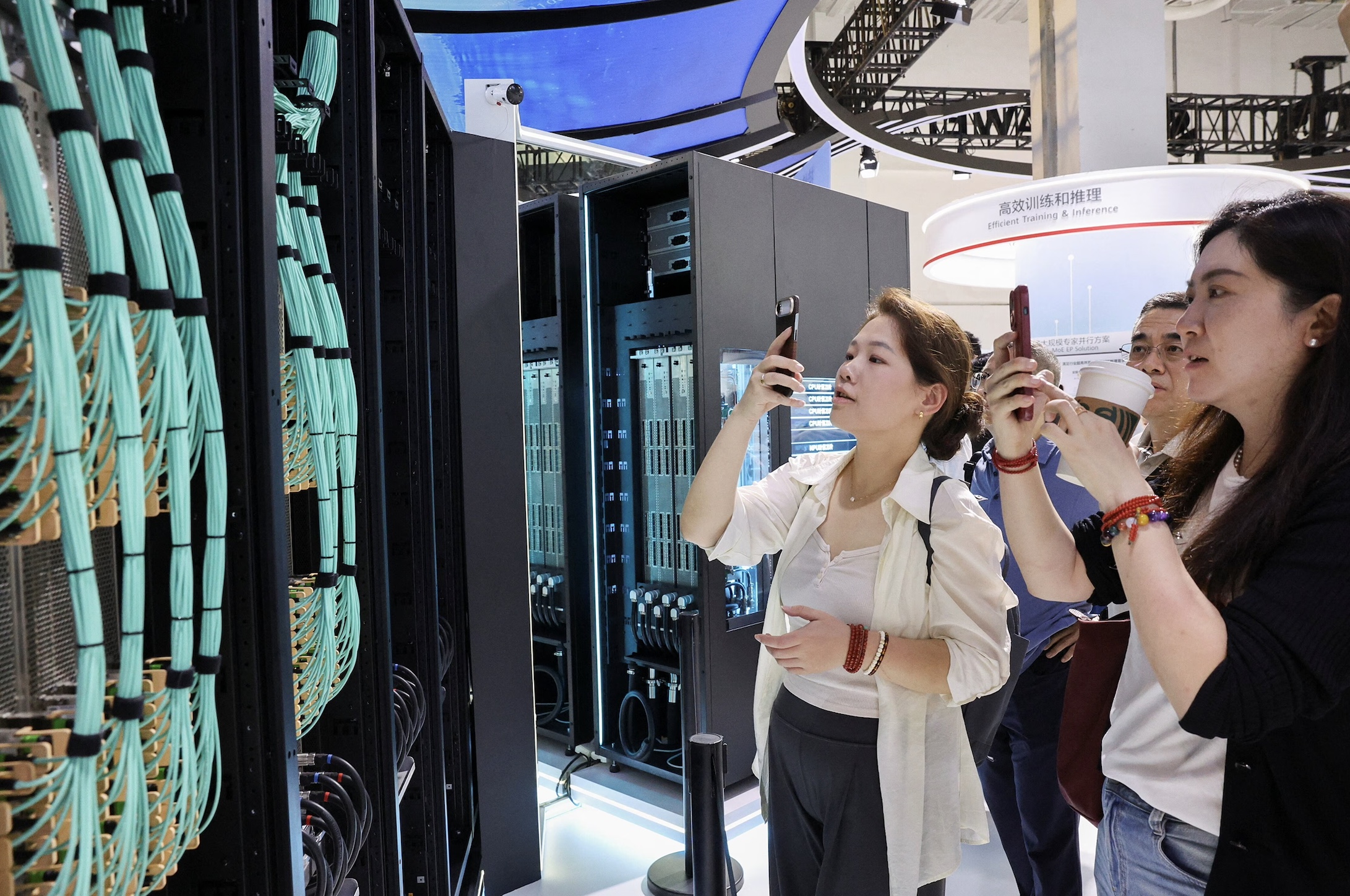
China is becoming an important test case for what comes after AI adoption: how companies redesign processes, develop people and build workforce systems around the technology.
How LONGi's Jiaxing solar factory uses AI quality inspection, with documented inspector-to-AI-trainer pathways, human verification and evidence limits on labour reduction.
Evidence from Salesforce, DBS, PwC US, LONGi and JD.com shows how AI changes tasks, roles, reskilling, redeployment and hiring before its full employment effects become visible.
How JD.com customer-service automation turns frontline experience into complex-care and AI-operations roles, and why AI-trainer work can itself face further automation.
Governance context
China’s AI governance model is best understood as a layered regulatory architecture rather than a single comprehensive AI statute.
Read the China Governance ProfileUse each source collection for its intended role: interpreted intelligence, documented work transitions, research, policy monitoring, and implementation cases.