
Evidence Brief · 劳动力转型
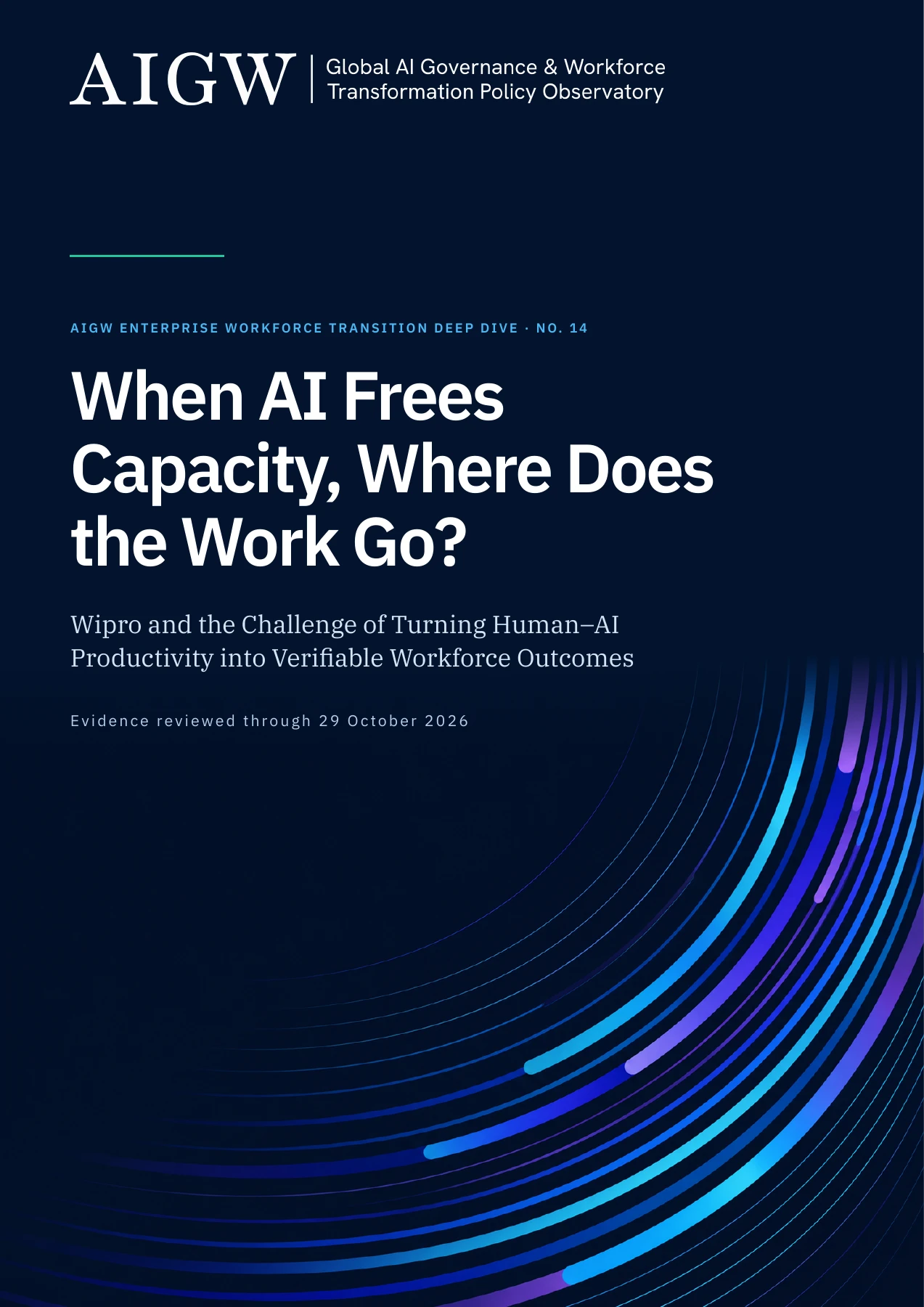
Wipro: AI Productivity, Redeployment and the 20,000-Worker Claim
Wipro says AI released productive capacity equivalent to 20,000 workers. This Deep Dive investigates redeployment, training, workforce changes and the evidence needed to establish what happened next.
概览
Wipro offers an important case of the growing distance between enterprise AI productivity claims and verifiable workforce outcomes.
In September 2026, Wipro's chief technology officer reported that the company's AI initiatives had released productive capacity equivalent to the output of approximately 20,000 employees, while describing redeployment into other work, training and evolving roles. The statement provides a meaningful account of management's workforce strategy, but the public record does not disclose the calculation behind the capacity estimate or the number, destinations and outcomes of individual employee transitions.
This 19-page AIGW Enterprise Workforce Transition Deep Dive examines that claim alongside Wipro's formal corporate disclosures, AI-enabled software-delivery practices, workforce training infrastructure and the establishment of an AI-Native Business & Platforms Unit. The company reported more than 60,000 employees using AI developer tools and substantial investment in GenAI training and role-based learning. These measures provide evidence of AI adoption and organizational investment, but not a complete account of individual proficiency, meaningful redeployment or career advancement.
The report also examines workforce data for the quarter ending September 2026. Wipro's reported headcount declined from 243,044 at the end of June to 236,328 at the end of September, a net change of 6,716 employees. That difference cannot be interpreted as AI-caused layoffs, nor directly reconciled with the earlier 20,000-worker capacity statement without information on hiring, attrition, individual transfers and other workforce flows.
Using AIGW's Workforce Architecture approach, the study distinguishes four possible routes for released productive capacity: reassignment to other client work, capability development, absorbing demand without replacing departures, and delivering additional business value. It proposes a practical measurement framework connecting task-level productivity, workforce flows, actual assignments, demonstrated skills, human authority and business outcomes.
The central conclusion is that released productive capacity is not itself a workforce destination. Enterprises must establish what happened to the work, who received new opportunities, how capabilities were used and whether the resulting changes created sustainable value for employees, customers and the business.
关键信息
关于本出版物
Suggested citation
AIGW Policy Observatory. (2026). When AI Frees Capacity, Where Does the Work Go? Wipro and the Challenge of Turning Human–AI Productivity into Verifiable Workforce Outcomes. AIGW Enterprise Workforce Transition Deep Dive (No. 14). https://gaeedu.org/publication/wipro-ai-productivity-redeployment-workforce-outcomes
References
相关出版物
Evidence Brief
比较研究
TCS: How AI Is Redesigning Graduate Training and Job Assignments
How Tata Consultancy Services connects AI training, graduate development and AI-assisted job assignment—and why skills investment alone cannot prove career progression.
比较从培训到工作分配的路径,以及衡量人工智能释放产能去向的挑战。
22 October 2026
报告
比较研究
Salesforce and Agentforce case study
An evidence-based case study of how Salesforce deployed Agentforce in customer support, redesigned human work, redeployed and reskilled employees, and reduced support staffing requirements without a simple one-to-one story of AI-driven lay…
比较两家企业人工智能转型中披露的岗位再配置与人员变化。
10/2/2026
Flagship Report
所应用的研究框架
Workforce Architecture for the AI Enterprise
Drawing on nine enterprise AI transitions, this flagship report examines how organizations redesign workflows, roles, capabilities, human authority and careers as AI moves from adoption into everyday operations.
应用劳动力架构方法,连接生产率、人员流动、能力与业务结果。
12 October 2026
Evidence Brief
比较研究
Human-in-the-Loop Is Not One Thing
Human presence is not human authority. Drawing on eight real-world AI deployments, this brief examines who can review, approve, override and make final decisions.
将智能体监督与人类审查、干预及决策权研究相联系。
9 October 2026