
Flagship Report · 劳动力转型
Workforce Architecture for the AI Enterprise
Drawing on nine enterprise AI transitions, this flagship report examines how organizations redesign workflows, roles, capabilities, human authority and careers as AI moves from adoption into everyday operations.
概览
Enterprise AI transformation is moving beyond tool adoption toward the institutional redesign of work. Drawing on nine enterprise transitions involving Salesforce, DBS, PwC US, LONGi, JD.com, SimplifyNext, Kaiser Permanente, Deutsche Telekom and BNY, this flagship report examines how organizations redesign workflows, roles, capabilities, human authority and careers as AI moves into everyday operations.
The report introduces the nine-domain AIGW Workforce Architecture Framework: Task, Workflow, Role, Capability, Learning, Authority, Career, Workforce Flow and Measurement. An enterprise diagnostic and an illustrative 12-month implementation roadmap connect these domains to Transition Capital, Learning Debt, workforce mobility and the governance of hybrid human–AI operations.
Designed for enterprise leaders, HR executives, technology leaders and policymakers, it offers an evidence-informed approach to aligning AI deployment with organizational design, human capability and accountable workforce transformation. The nine cases are purposively selected to identify transition mechanisms, not representative economy-wide outcomes. The framework is not presented as a validated scoring model, and the case evidence does not establish that automation necessarily caused layoffs.
完整摘要
Enterprise AI transformation is moving beyond tool adoption toward the institutional redesign of work. Drawing on nine enterprise transitions involving Salesforce, DBS, PwC US, LONGi, JD.com, SimplifyNext, Kaiser Permanente, Deutsche Telekom and BNY, this 65-page AIGW report examines how AI changes task allocation, operating workflows, job responsibilities, capability requirements, professional learning, decision authority, career pathways and workforce flows.
It introduces the nine-domain AIGW Workforce Architecture Framework, supported by an enterprise diagnostic and an illustrative 12-month implementation roadmap. The report identifies challenges including Learning Debt, the preservation of Transition Capital, workforce mobility and the governance of hybrid human–AI operations.
Designed for enterprise leaders, HR executives, technology leaders and policymakers, it offers an evidence-informed approach to aligning AI deployment with organizational design, human capability and accountable workforce transformation.
The nine cases are purposively selected to identify transition mechanisms, not to establish representative economy-wide outcomes.
关键信息
The nine transition archetypes
AIGW purposively selected nine cases to compare observable workforce transition mechanisms. The sample does not estimate how common the mechanisms are across the economy or establish that the outcomes generalize to other organizations.
| Organization | Primary transition | Strongest evidence | Main boundary and report references |
|---|---|---|---|
| Salesforce | Support automation, role redesign and lower staffing requirement | Millions of AI-handled conversations. Hundreds redeployed. Reported support headcount fell from roughly 9,000 to roughly 5,000. | The exact split among redeployment, attrition, non-backfill and involuntary exits is not public. |
| DBS | AI-linked operating-model transformation | Nine OMTs. More than 11,000 employees were identified for deeper reskilling or upskilling, and 96% commenced. | Bank-wide value and model counts cannot be causally attributed to specific workforce transitions. |
| PwC US | Entry-level audit role and apprenticeship redesign | AI embedded in audit. More than 17,000 assurance users of ChatNational. Structured AI training and planned pressure on entry intake. | Hiring contraction has multiple causes. AI alone does not explain the planned decline. |
| LONGi | Frontline inspection automation and expert transition | AI inspection across nine procedures and 198 items, with human double-checks and a documented transition from inspector to AI trainer. | One named worker does not establish a universal pathway. Lower labour cost does not prove layoffs. |
| JD.com | Basic service automation, AI operations and role transition | 4.2 billion AI service inquiries. Thousands of reported job transitions or upgrades. A named pathway from customer service to AI trainer. | “Thousands transformed” does not establish thousands of net-new jobs. The current denominator and destination mix remain unclear. |
| SimplifyNext | Employment-first AI apprenticeship | Close to 50 trainees hired, with real project participation and more than 90% reported project-leading responsibility. | Long-term retention, pay and the precise authority associated with “leading” are not public. |
| Kaiser Permanente / TPMG | Documentation automation with explicit professional authority | 7,260 physicians, 2.57 million encounters and approximately 15,791 estimated documentation hours saved. | The evidence does not establish improved clinical outcomes or a reduction in physician staffing. |
| Deutsche Telekom | Agentic network operations | Autonomous corrective actions. Selected processes fell from roughly an hour to minutes. More than 100 remediation actions were reported after launch. | Use-case-level approval, veto and override arrangements are not fully public. |
| BNY | Employee-built agents and a digital workforce | 100% access. 171,000 AI learning hours. Nearly 50% building agents. 134 digital employees live in 2025. | Training does not establish proficiency. Digital employees are not equivalent to human FTEs. Full workflow authority is not public. |
Apply This Research
The full original report remains free.
Work with AIGW
Discuss an institutional diagnostic, research engagement or workshop on workforce transformation.
Discuss a WorkshopApply It Yourself
Workforce Architecture Discovery Toolkit complements the report with practical prompts. Proposed pilot price: USD $9, one-time. Early Access / In Preparation. Early access is not a purchase.
Explore the toolkit and free sample关于本出版物
Suggested citation
AIGW Policy Observatory. (2026). Workforce Architecture for the AI Enterprise: What Nine Enterprise Transitions Reveal About Redesigning Work, Roles, Capability, Authority and Careers. From AI Adoption to Workforce Architecture — 2026 Enterprise Evidence Report. https://gaeedu.org/publication/workforce-architecture-for-the-ai-enterprise
相关出版物
报告
本研究引用的案例
Salesforce and Agentforce case study
An evidence-based case study of how Salesforce deployed Agentforce in customer support, redesigned human work, redeployed and reskilled employees, and reduced support staffing requirements without a simple one-to-one story of AI-driven lay…
本研究考察的九个企业转型案例之一。
10/2/2026
Evidence Brief
本研究引用的案例
DBS: How AI Is Redesigning Banking Roles, Reskilling and Redeployment
How DBS connects enterprise AI deployment to banking role redesign, reskilling and internal mobility, with evidence on operating-model transformation and changing hiring demand.
本研究考察的九个企业转型案例之一。
October 2026
Evidence Brief
本研究引用的案例
PwC: How AI Is Reshaping Entry-Level Audit and the Graduate Career Pipeline
How PwC US is redesigning junior audit roles around AI, review and professional judgment, while rebuilding apprenticeship and planning a smaller graduate intake.
本研究考察的九个企业转型案例之一。
October 2026
Evidence Brief
本研究引用的案例
LONGi: How AI Quality Inspection Is Turning Frontline Expertise into AI Training
How LONGi's Jiaxing solar factory uses AI quality inspection, with documented inspector-to-AI-trainer pathways, human verification and evidence limits on labour reduction.
本研究考察的九个企业转型案例之一。
October 2026
Flagship Report
本研究引用的案例
JD.com: How Customer Service AI Is Redesigning Roles, AI Training and Complex Customer Care
How JD.com customer-service automation turns frontline experience into complex-care and AI-operations roles, and why AI-trainer work can itself face further automation.
本研究考察的九个企业转型案例之一。
October 2026
Evidence Brief
本研究引用的案例
SimplifyNext: How Paid AI Training and Client Projects Build Entry-Level Career Pathways
How SimplifyNext and Singapore’s IMDA Company-Led Training connect paid employment, mentoring and client AI projects to graduate and mid-career entry pathways.
本研究考察的九个企业转型案例之一。
October 2026
Evidence Brief
本研究引用的案例
Kaiser Permanente: How Ambient AI Scribes Reduce Documentation Work While Physicians Retain Clinical Authority
How Kaiser Permanente scales ambient AI scribes to reduce physician documentation burden while preserving patient permission, clinical review and final human decision authority.
本研究考察的九个企业转型案例之一。
October 2026
Evidence Brief
本研究引用的案例
Deutsche Telekom: How AI Agents Automate Network Operations and Expose Gaps in Human Control
How Deutsche Telekom’s RAN Guardian agents automate live mobile-network monitoring and corrective action, with evidence on faster operations and the limits of public human-control and workforce data.
本研究考察的九个企业转型案例之一。
October 2026
Evidence Brief
本研究引用的案例
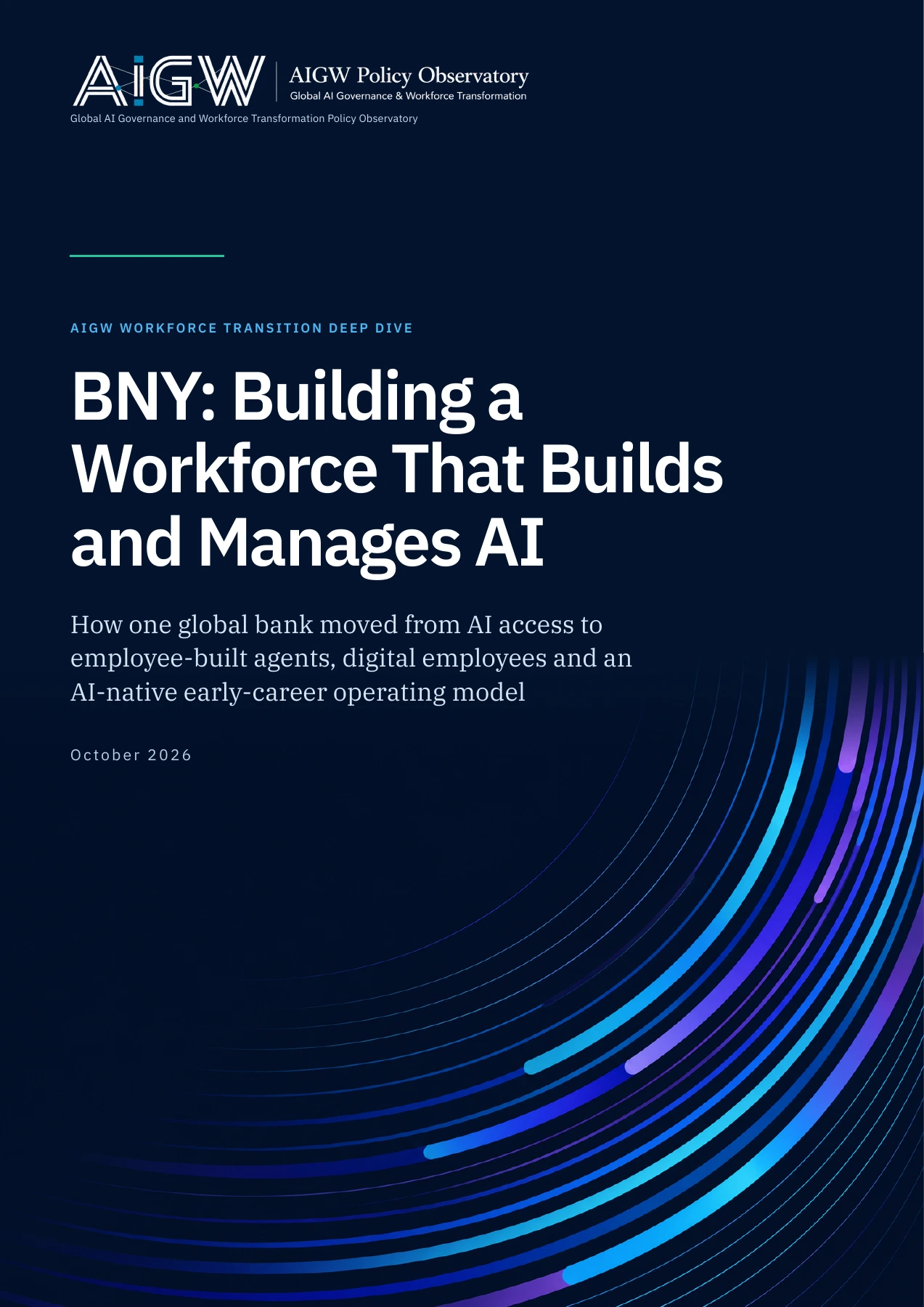
BNY: Building a Workforce That Builds and Manages AI
A deep dive into how BNY moved from enterprise-wide AI access to employee-built agents, digital employees and an AI-enabled workforce operating model.
本研究考察的九个企业转型案例之一。
October 2026
Explore Research Tools & Services
企业劳动力研究与合作
欢迎共同研究企业中的工作重构、能力发展与人类决策权,并交流有据可查的实施经验。
交流企业实施研究