治理发展

Policy Tracker

Tracking how governments, regulators, standards bodies, and international organizations are shaping the rules, institutions, and implementation conditions for responsible AI adoption.

Country, regional, regulatory, standards, and international organization developments in AI governance.

资源库筛选

按资源类型、受众、地理区域、主题和年份搜索。

37 项资源
Policy TrackerPolicy Tracker NoteChina

MIIT notice on agent-enabled terminal network access

China. Notice 工信厅信管〔2026〕42号, signed 24 October, covers preinstalled agents in phones, tablets and wearables, including adaptation tests, device access, upgrades and distribution. It is not a general AI Act.

2026-11-06
Policy TrackerPolicy Tracker NoteUnited States

Department of Education proposed supplemental priorities and definitions

United States. Federal Register document 2026-22615, docket ED-2026-OS-3169, proposes education grant priorities including AI and workforce readiness. Comments close 7 December 2026. It is not a final rule or statutory redefinition of AI.

2026-11-05
Policy TrackerPolicy Tracker NoteUnited Kingdom

Limited EU AI Act application in Northern Ireland — UK guidance

United Kingdom. The UK guidance describes specific and limited EU AI Act application in Northern Ireland under the Windsor Framework from 10 November 2026, with product and supply-chain scope to be assessed. It does not apply the entire Act across the UK.

2026-11-04
Policy TrackerPolicy Tracker NoteOther

Australian Government AI Reference Architecture

Australia. DTA announced a reference architecture for public agencies designing and governing AI systems, including assurance and human oversight. The architecture is guidance, not a national AI statute.

2026-10-30
Policy TrackerPolicy Tracker NoteIndia

TRAI draft responsible AI guidelines for telecommunications

India. TRAI published draft responsible AI guidance for telecommunications networks and services. Comments close 27 November 2026; the guidance is not final.

2026-10-30
Policy TrackerPolicy Tracker NoteOther

Privacy regulators’ resolution on AI in health and health research

Canada. A joint resolution adopted on 15 September and announced on 29 October calls for privacy safeguards, risk assessment and oversight across health AI and research. It is not new legislation.

2026-10-29
Policy TrackerPolicy Tracker NoteUnited Kingdom

UK AI security and institutional investment package — October 2026

United Kingdom. Announced government funding and capacity-building — not enacted AI obligations or proof of completed delivery. The package announces £165m for biosecurity, including a £100m AI Biosecurity Lab, plus £120m additional AISI investment, £60m National Cyber Shield and £70m NERV Centre. These are announced commitments, not evidence all funding is appropriated, spent or institutions operational.

2026-10-24
Policy TrackerPolicy Tracker NoteChina

China National Informatization 15th Five-Year Plan (2026–2030)

China. National strategic plan / administrative coordination guidance — not an independently enforceable AI statute. The national plan directs information infrastructure, intelligent-society governance, security, digital skills and standards development. Its priorities and indicators do not independently create enterprise AI compliance duties; separate applicable law and standards determine obligations.

2026-10-23
Policy TrackerPolicy Tracker NoteChina

State Council opinion on employment-friendly AI development

China. Opinion 国办发〔2026〕29号, signed 16 October, directs job creation, worker skills and transition support, employment risk assessment and monitoring. It is a policy opinion, not a new labour statute.

2026-10-23
Policy TrackerPolicy Tracker NoteUnited States

U.S. housing-finance automation executive order (2026)

United States. Executive order — conditional sectoral executive direction, not horizontal AI legislation. The order invokes Super Intelligence and directs conditional FHFA action on a prospective mortgage-insurance pilot using automated valuations and expansion of automated title-risk review for eligible refinancing. Existing legal and safety safeguards remain; it neither establishes that all AVMs use AI nor confirms implementation has begun.

2026-10-22
Policy TrackerPolicy Tracker NoteOther

Fair Work Commission requirements for GenAI in cases

Australia. Participants using GenAI to prepare Commission case documents must disclose its use and check accuracy and relevance; witness statements must reflect personal knowledge and truthful words. The requirements concern Commission proceedings.

2026-10-20
Policy TrackerPolicy Tracker NoteJapan

Japan Gennai governance, security and safety standard — first edition

Japan. Government-platform operating standard — scoped to Gennai, not general national AI law. The first-edition Gennai Standard assigns responsibilities to users, administrators and developers of the government platform. Agent Chat deployment is phased; the roughly 180,000-person programme target is not an active-user count. Gennai Workshop around December 2026 and OSS v2.0 around February 2027 remain planned.

2026-10-20
Policy TrackerPolicy Tracker NoteUnited States

Key Practices for Incident Readiness and Response in Super Intelligence Training and Evaluation

United States. Voluntary AI / artificial intelligence guidance for frontier models and agent incidents: NIST, NSA and CISA published ten Super Intelligence incident-readiness practices on 16 October 2026, covering preparation, detection, response, recovery and reporting. No new general mandatory reporting duty.

2026-10-16
Policy TrackerPolicy Tracker NoteUnited Kingdom

UK national AI resilience and autonomous-agent incident preparedness

United Kingdom. The 12 October 2026 AI resilience package expands cyber-defence work and autonomous-agent incident preparedness. Government is considering stronger protections, including serious-incident and near-miss reporting, through the Cyber Security and Resilience Bill regime. This announcement does not enact mandatory AI incident reporting.

2026-10-12
Policy TrackerPolicy Tracker NoteSingapore

MAS AI Risk Management Guidelines for Financial Institutions (2026)

Singapore. Final MAS AI risk-management guidelines set sectoral supervisory expectations for financial institutions, not a binding horizontal AI Act. Sections 3–4 apply from 2027-10-07; sections 5–6 are expected by 2028-10-07. Published 7 October 2026.

2026-10-07
Policy TrackerPolicy Tracker NoteUnited Kingdom

UK healthcare AI Commission response and AI Airlock Phase 3

Government policy response / sectoral regulatory implementation — not enacted legislation. On 6 October 2026 the government accepted all 44 recommendations of the National Commission into the Regulation of AI in Healthcare. MHRA opened AI Airlock Phase 3 applications, focusing on post-market surveillance and lifecycle oversight for AI-enabled medical devices. These are implementation commitments and sandbox activity, not a newly enacted law.

2026-10-06
Policy TrackerPolicy Tracker NoteEuropean Union

Draft Commission guidelines on high-risk AI classification

European Union. Draft non-binding guidance — not final as of 2026-10-03. The official high-risk classification page continues to describe draft guidelines. This is separate from the final Article 50 transparency guidelines.

2026-10-03
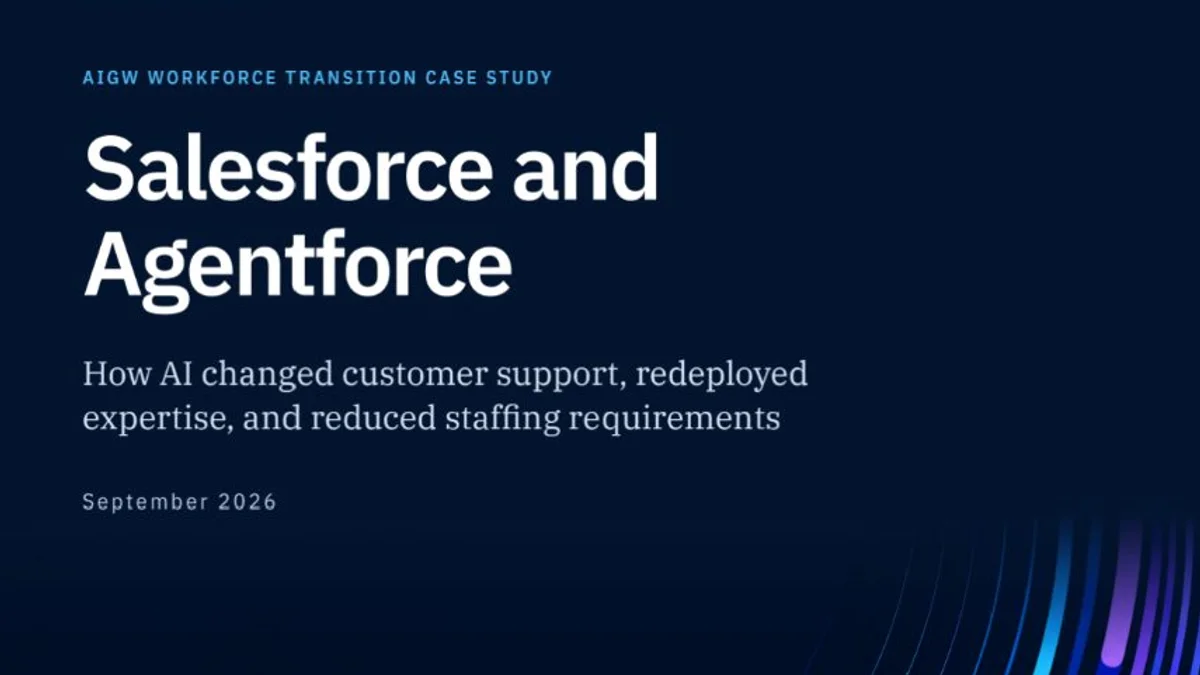
Landscape discovery crop from the original Salesforce and Agentforce case study cover
洞察出版Global

Salesforce and Agentforce case study

An evidence-based case study of how Salesforce deployed Agentforce in customer support, redesigned human work, redeployed and reskilled employees, and reduced support staffing requirements without a simple one-to-one story of AI-driven layoffs.

10/2/2026
Policy TrackerPolicy Tracker NoteOther

Canada frontier-AI cyber security readiness — federal SPIN

Canada. Federal administrative security-policy direction — binding within the existing in-scope government policy chain. Effective 1 October, the SPIN reinforces existing government security/digital requirements for organizations covered by section 6 of the Policy on Government Security. It prioritizes critical services, baseline controls and assume-breach recovery. It is not a universal private-sector AI statute.

2026-10-01
Policy TrackerPolicy Tracker NoteKorea

South Korea public-sector AI ethics standards — final framework

South Korea. MOIS finalised public-sector AI ethics standards on 1 October 2026: six core values, 68 detailed checks and three tailored self-assessment levels. This is a final non-binding practical framework, separate from the AI Basic Act and public-sector AI/data legislation.

2026-10-01
Policy TrackerPolicy Tracker NoteJapan

Government AI “Gennai” — public-sector implementation programme

Japan. Public-sector implementation and capacity signal — not legislation. The official page, updated on 2026-09-30, describes an FY2026 demonstration targeting approximately 180,000 central-government personnel, evaluation of benefits and challenges ahead of wider FY2027 deployment, and a dashboard to visualize government use. This is implementation of Japan’s promotion-led model, not a new enterprise AI law.

2026-09-30
Policy TrackerPolicy Tracker NoteOther

OAIC automated-decision transparency guidance — September 2026

Australia. Regulator guidance — supporting an enacted future requirement, not a new Act. The Privacy and Other Legislation Amendment Act 2024 enacted APP privacy-policy transparency requirements commencing 2026-12-10. They apply where an APP entity arranges for a computer program to make, or do something substantially and directly related to making, a decision that could reasonably significantly affect an individual’s rights or interests, and uses personal information about that individual in the program. As of 2026-10-03 these requirements are enacted but not yet applicable.

2026-09-30
Policy TrackerPolicy Tracker NoteUnited States

Executive Order 14434 — Inaugurating the Era of Super Intelligence

United States. Executive order — executive-branch direction within lawful authority. To the maximum extent permitted by law, departments and agencies must use “Super Intelligence” / “SI” in specified non-statutory executive-branch materials. Previously issued regulations, Presidential actions, contracts, grants and historical documents need not be altered. For this order SI incorporates the existing AI definition in 15 U.S.C. § 9401(3); Congress has not changed that statutory definition. This is not a new horizontal enterprise AI statute.

2026-09-29
Policy TrackerPolicy Tracker NoteChina

GB/T 45288.5-2026 — Multimodal large-scale model

China. Recommended national standard — non-mandatory; effective 2027-01-01. Provides a technical reference for multimodal large models. This GB/T recommended standard or GB/Z guiding technical document is not automatically a mandatory legal obligation; any binding incorporation must be assessed separately.

2026-09-28
Policy TrackerPolicy Tracker NoteChina

GB/T 48324-2026 — Technical requirements for large-scale model systems of government

China. Recommended national standard — non-mandatory; effective 2027-04-01. Provides a technical reference for government large-model systems. This GB/T recommended standard or GB/Z guiding technical document is not automatically a mandatory legal obligation; any binding incorporation must be assessed separately.

2026-09-28
Policy TrackerPolicy Tracker NoteUnited States

NIST ARIA Evaluation Planning Manual

United States. Official technical / evaluation guidance — non-binding. ARIA-style evaluation planning combines model testing, red teaming and user testing. The manual is an official evaluation methodology, not binding federal AI law.

2026-09-18
Policy TrackerPolicy Tracker NoteChina

Artificial Intelligence Safety Governance Framework 3.0

China. Official governance framework — non-binding guidance, not law. Updates AI safety-risk classification and technical and comprehensive governance responses, retaining the risk classification — technical response — comprehensive governance logic.

2026-09-14
Policy TrackerPolicy Tracker NoteOther

Government of Canada AI Register — transparency implementation

Canada. Public-sector transparency implementation / consultation report — non-binding. The 2026-09-11 What We Heard consultation report records feedback on the MVP AI Register. Treasury Board says it will use the feedback to develop an improved version replacing the MVP and updated regularly. The report is a non-binding public-service transparency implementation signal, not private-sector AI legislation.

2026-09-11
Policy TrackerPolicy Tracker NoteUnited Kingdom

DSIT AI Risk Management Toolkit

United Kingdom. Official government guidance / risk-management toolkit — non-binding. Supports people designing, operating, procuring or delivering AI-enabled products. It is a practical government risk-management reference, not regulation or a new statutory duty.

2026-09-08
Policy TrackerPolicy Tracker NoteSingapore

IMDA Transparency Guidelines for Generative AI Chatbots — voluntary baseline

Singapore. Voluntary guidance; official policy clarification, not new regulation. MDDI’s 2026-09-08 parliamentary response confirms that IMDA’s Transparency Guidelines for Generative AI Chatbots are a voluntary baseline. Consideration of stronger requirements for sensitive uses depends on deployment context, potential harms and effectiveness of existing measures. The response is policy clarification, not a new rule or mandatory horizontal AI regime.

2026-09-08
Policy TrackerPolicy Tracker NoteKorea

AI Basic Act Enforcement Decree — high-impact AI implementation

South Korea. Binding Presidential Decree / subordinate legislation. Binding Presidential Decree, current version in force from 2026-08-20. Article 25 permits a business to request high-impact AI classification confirmation from the Minister of Science and ICT, submitting the product/service overview, development/training-data overview, materials demonstrating use process/results and other relevant documents. This confirmation procedure is distinct from Article 23 transparency, Article 27 high-impact business duties and Article 28 impact-assessment provisions.

2026-08-18
Policy TrackerPolicy Tracker NoteEuropean Union

AI Act Article 50 transparency obligations and final guidance

European Union. Binding AI Act obligations + final non-binding Commission guidance. Article 50 generally applies from 2026-08-02. For systems placed on the market before that date, only the Article 50(2) marking/detection obligation has the limited transition to 2026-12-02.

2026-07-20
Policy TrackerPolicy Tracker NoteEuropean Union

Commission Implementing Regulation (EU) 2026/1755

European Union. Binding implementing regulation — in force and directly applicable from 2026-08-10. Published in the Official Journal on 2026-07-21, the regulation establishes detailed arrangements for certain Commission proceedings under the AI Act, including procedures connected to Articles 92 and 101 and general-purpose AI evaluation and enforcement. It is legislation, not guidance.

2026-07-20
What OpenAI, GitLab, Gartner and the EU AI Act Reveal About the Next Enterprise AI Bottleneck
洞察咨询说明United States

What OpenAI, GitLab, Gartner and the EU AI Act Reveal About the Next Enterprise AI Bottleneck

Recent signals from OpenAI, GitLab, Gartner, and the European Commission suggest that enterprise AI adoption is entering a new phase. The challenge is no longer simply whether organizations can access powerful AI tools, but whether they can redesign workflows, govern agents, prepare semantic infrastructure, and operationalize transparency requirements.

May 13, 2026
From Classroom Readiness to Workforce Readiness
Policy Tracker出版Global

From Classroom Readiness to Workforce Readiness

A flagship policy brief arguing that AI education, assessment, governance, and workforce transformation should not be treated as separate debates, but as one institutional transition sequence connecting classrooms, learning systems, and the future of work.

4/24/2026
AI in Education Policy: What Five Countries Reveal About Readiness, Inclusion and Implementation
Policy TrackerCountry Governance ProfileGlobal

AI in Education Policy: What Five Countries Reveal About Readiness, Inclusion and Implementation

Artificial intelligence is entering classrooms faster than many education systems can decide whether they are ready for it — or how it should be used. That makes AI in education not only a technology …

March 28, 2026
Policy TrackerPolicy Tracker NoteOther

Privacy and Other Legislation Amendment Act 2024 — automated-decision transparency

Australia. Enacted statutory requirement — not yet applicable as of 2026-10-03. The Privacy and Other Legislation Amendment Act 2024 enacted APP privacy-policy transparency requirements commencing 2026-12-10. They apply where an APP entity arranges for a computer program to make, or do something substantially and directly related to making, a decision that could reasonably significantly affect an individual’s rights or interests, and uses personal information about that individual in the program. As of 2026-10-03 these requirements are enacted but not yet applicable.

2024-12-10